How Much Does a Domain Name Cost?
- Written by ZonWhois Editorial Team
- Reviewed by ZonWhois Editorial Team
- Last checked
- Published on
- In Buying Registering Domains
A domain name costs a yearly fee, not a one-time price, and the amount depends on the extension, the registrar and whether you are paying a first-year or renewal price. Part of the fee is set by the registry, part is the registrar's margin, and premium names can cost far more. Compare the renewal price, not just the first year.

Section of: How to Buy a Domain Name
Domain pricing has no single answer, which is why this page gives a structure instead of a number. The buying steps are in the purchase walkthrough; this page explains what you are paying for. It quotes a figure only where a dated primary source exists.
Short answer: a range, not a price (and why)
Every registrar sets its own retail price and changes it over time, so any price printed here would go stale. What is stable is the structure: a registry fee, a registrar margin and a term. The one dated figure this guide can source is for .com, shown below.
| Item | Figure | Source and date |
|---|---|---|
| .com registry Maximum Price (starting point) | US $10.26 per registration year, excluding the ICANN variable fee | ICANN-VeriSign .com Registry Agreement, effective 1 December 2024, section 7.3(d)(i) |
This is the registry’s wholesale cap, not what you pay at a registrar, and it can rise under section 7.3(d). Treat it as dated information, not a current quote.
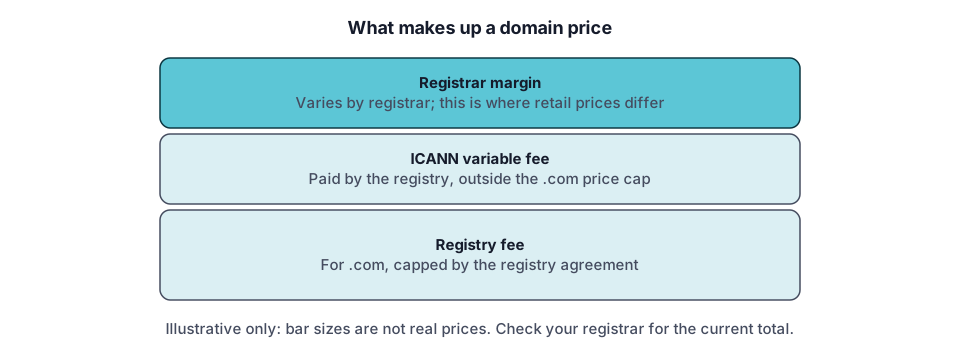
What makes up the price (registry fee, ICANN fee, registrar margin)
- Registry fee: for .com, capped by the agreement above.
- ICANN fee: the agreement refers to an ICANN variable registry-level fee, paid by the registry and excluded from the cap.
- Registrar margin: whatever the registrar adds, which is where retail prices differ.
First-year vs renewal pricing
The renewal price is what you pay in every later year. The .com agreement lets the registry raise its cap by up to 7% in each of the final four Pricing Years of every six-year period, with at least six months’ notice, so renewals can move even when you do nothing. For a fair comparison, add up the cost over the years you expect to keep the name.
Add-ons you can skip (privacy, email, site builders)
Many checkouts offer extras. Public registration data may already be redacted at no charge; see WHOIS privacy before you pay for it. Email and site builders are separate products from the domain registration and you can add them later or not at all.
Premium and aftermarket names
A premium or aftermarket name is priced by the seller, not by the standard registry cap. Confirm the first-year and renewal price, and whether you are buying a registration or a transfer from the current holder.
How to compare registrars honestly (checklist, no rankings)
This site does not rank registrars. Use the same checklist for each: renewal price, term options (up to ten years is possible for .com at the registry level), transfer rules, how contact data is displayed, account security and notice emails. Check that the company appears on ICANN’s list of accredited registrars if you are registering a generic extension.
Costs of transfers and redemption
Moving a name to another registrar has its own rules; see how to transfer a domain. A name that lapses may be recoverable under the Expired Registration Recovery Policy, check your registrar’s terms for any fee; see expired domains. For .com specifics see registering a .com. Allow for the waiting time as well (how long a transfer takes) and for registrar-specific steps such as the Cloudflare Registrar transfer steps.
Record check: claims compared with the cited ICANN, IANA and IETF documents on 2026-11-17; see the editorial policy.
Frequently asked questions
Why is the first year cheap?
A registrar may discount the first year to win your order and charge the regular price at renewal. Nothing in the registry agreement requires the two to match, because the registry sets only a wholesale maximum. Read the renewal price on the checkout page, and divide the total over the years you expect to keep the name before you compare offers.
Is a domain a one-time or yearly cost?
It is a recurring cost. You register a name for a term, one year or longer, and renew before it expires. For .com the registry must offer terms up to ten years, so you can prepay, but you still need to renew at the end. A missed renewal can lead to extra recovery steps, so check your registrar's terms.
What is a premium domain?
A premium domain is a name that a registry or registrar prices above the standard rate, usually because it is short, a common word or otherwise in demand. The price can be much higher than a standard registration and may renew at a higher rate too. Ask whether the renewal price is also premium before you buy.
Does ICANN charge a fee?
ICANN receives fees from registries and registrars, and the .com agreement refers to an ICANN variable registry-level fee that is excluded from the registry's maximum price. Individual registrants do not pay ICANN directly. If a checkout shows an ICANN line item, ask the registrar what it covers.
Why do renewal prices change?
Registries can raise wholesale prices within their agreement. The .com agreement allows up to 7% in each of the final four Pricing Years of every six-year period, with six months' notice. Registrars also change retail prices for their own reasons. Check the renewal price shown in your account before the date, not the price you paid last year.
Sources and further reading
- ICANN and VeriSign: .com Registry Agreement (effective 1 December 2024) (itp.cdn.icann.org)
- ICANN: Consensus policies for registrars (icann.org)
- IANA: .com delegation record (iana.org)
You might also like
- How to Buy a Domain Name
How to buy a domain name in five steps: pick the name, choose an accredited registrar, compare renewal and transfer terms, check out and verify.
- Register a .com Domain Name
Register a .com domain name: who runs .com, how registry and registrar differ, the five steps, renewal rules and what to try if the .com is taken.
- How to Register a Domain Name Step by Step
Register a domain name in six steps: check the name, open a registrar account, enter accurate details, pick a term, verify your email and set nameservers.