Expired Domains: How They Work
- Written by ZonWhois Editorial Team
- Reviewed by ZonWhois Editorial Team
- Last checked
- Published on
An expired domain is one whose registration term ended without renewal. Under ICANN's Expired Registration Recovery Policy the owner can usually still renew for a time, generic registries must offer a 30-day redemption period after deletion, and only after the name is purged can anyone register it again. Exact day counts vary by registrar and registry.

Reviewed by the editorial desk against the cited ICANN and Google sources on 2026-11-17.
An expired domain is a domain name whose paid registration term has ended without renewal. The owner can usually still renew for a while, and the name is only released for others to register after a deletion process. This guide gives the order of events and links to detail pages.
What happens when a domain expires?
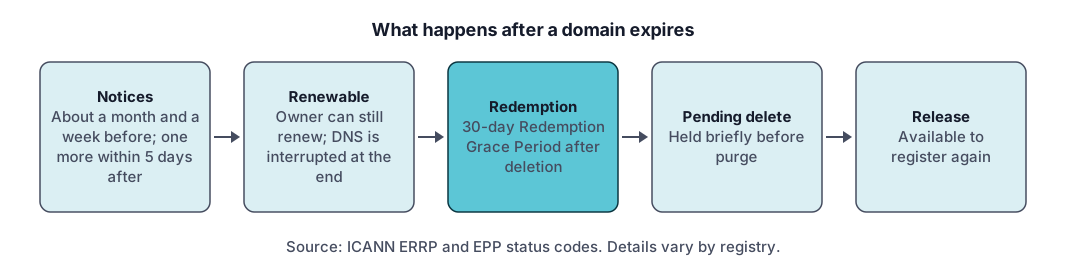
The domain moves through a sequence of stages: notices, a renewable period, deletion, a redemption period and release. ICANN’s Expired Registration Recovery Policy sets rules for the first stages and for the 30-day redemption period.
- Before expiry. Registrars must send two notices: one about a month before and one about a week before. The policy’s notes accept 26 to 35 days and 4 to 10 days.
- After expiry. If the domain is neither renewed nor deleted, the registrar must send at least one more notice within five days. The policy also requires DNS resolution to be interrupted for at least the last eight consecutive days the owner can still renew, so a site or email may stop working before the name is lost.
- Deletion and redemption. gTLD registries must offer a 30-day Redemption Grace Period after deletion, and registrars must let the owner redeem in that window.
- Pending delete and release. Afterwards the domain is purged and can be registered again under registry policy.
Registries and registrars differ, so check your registrar for its actual dates and fees. Our detail page is domain expiration, grace and redemption periods.
What are the grace, redemption and pending delete periods?
These are the registry statuses a domain passes through around deletion. ICANN’s status-code page defines each.
- autoRenewPeriod: a short grace period after the registry automatically renews an expired domain. ICANN gives no fixed number of days.
- redemptionPeriod: the registrar has asked the registry to delete the domain, and it is held for 30 days. To keep it, contact your registrar immediately.
- pendingDelete: after 30 days in redemption without restoration, the domain stays in this status for several days before it is purged.
How do you renew an expired domain you own?
Renew through your registrar as soon as you notice. The policy requires registrars to let the registrant renew from expiration through the interruption period (section 2.2.5), and to restore your DNS settings immediately or as soon as is commercially reasonable afterward (section 2.2.6). If the domain has reached redemption, the registrar has to let you redeem it, and may charge a redemption fee. The policy requires registrars to display renewal, post-expiration and redemption fees, and ICANN’s deletion policy says they should disclose the recovery fee. Read your registrar’s page for the amounts.
How can you see when a domain expires?
The expiry date is in your registrar account and usually in the domain’s public record. See how to check when a domain expires, or look a name up directly with the WHOIS and RDAP lookup tool.
How are expired domains re-registered?
After the name is purged it becomes available to register like any other. ICANN says that once deletion occurs the domain is available for re-registration in accordance with the registry’s policies, so the exact timing and method depend on the registry. Common routes are described in buying a released name.
What are the risks of buying an expired domain?
The name may carry history you do not want, and it may be risky if you intend to use it for rankings. Google’s spam policies define expired domain abuse as buying an expired domain and repurposing it primarily to manipulate rankings by hosting content of little to no value. Its examples include affiliate content on a former government site. Check what a name was used for and whether it conflicts with a trademark before buying.
How do you check a name is really available?
A registry record that shows no registration is a good sign, but the registrar’s search is the final check. Our guide to checking domain name availability explains why, and the domain buying guide covers the purchase itself.
How do you spot renewal scams?
Treat unexpected renewal notices cautiously and renew only through your own registrar account. ICANN’s policy requires registrars to describe on their websites how they send pre- and post-expiration notices (section 4.2), so compare any notice with your registrar’s description. Navigate to your registrar directly instead of using links in the message.
Related: editorial policy.
All Expired Domains guides
- Check Domain Name Availability
How to check if a domain name is available: use a registrar search for the final answer, a lookup as a hint, and check variations and trademarks.
- Domain Expired: Grace and Redemption Periods
What happens after a domain expires: renewal notices, DNS interruption, the 30-day redemption period and pending delete, and how to recover it.
- How to Buy an Expired Domain
How to buy an expired domain: why expired does not mean available, the routes to a name, checks before you pay, risks and Google's spam policy.
- How to Check When a Domain Expires
Find a domain's expiration date in a public RDAP or WHOIS record or your registrar account, and why the date can be missing or differ.
Frequently asked questions
What happens when a domain name expires?
The registration stops being valid unless it is renewed, and the registrar must warn you before and after expiry under ICANN's Expired Registration Recovery Policy. Depending on the registrar, the site and email may stop resolving while you can still renew. If the name is not renewed, it is deleted, enters a redemption period and is finally released for anyone to register.
Can I get my expired domain back?
Often yes. The policy requires registrars to let the owner renew for a period after expiry, and gTLD registries must offer a 30-day redemption period after deletion. Registrars must display their redemption fees, so check what yours charges. Contact your registrar immediately, because the windows differ by registrar and extension.
How long until an expired domain is released?
ICANN's status-code page says a domain sits in redemptionPeriod for 30 days after deletion is requested, then in pendingDelete for several days before it is purged. The registrar's own grace period before deletion varies and is not fixed by that page, so there is no single number. Check your registrar's stated policy.
Are expired domains free to register?
Generally no. Once a name is released, it is registered like any other name at the registrar's price, and popular names can be contested by several buyers. Nothing in ICANN's policies makes released domains free. We do not quote prices because they change; see your registrar's fee page and our guide to buying an expired domain.
How do I know when my domain expires?
Your registrar account shows the renewal date, and a public RDAP or WHOIS record normally carries an expiration event. Registrars must also send notices about a month and a week beforehand. Make sure the contact email is current and auto-renew is on, then check the date with a lookup tool.
Is buying expired domains for SEO safe?
It carries risk. Google's spam policies name expired domain abuse, buying an expired domain to repurpose it mainly to manipulate rankings with content of little value to users, as a violation. A name can also carry an unwanted history or trademark problems. Check what the name was used for and avoid buying only for borrowed rankings.
Sources and further reading
- ICANN Expired Registration Recovery Policy (icann.org)
- ICANN EPP status codes: what they mean (icann.org)
- ICANN Expired Domain Deletion Policy (icann.org)
- ICANN consensus policies (icann.org)
- Google Search Central: spam policies (expired domain abuse) (developers.google.com)
You might also like
- Check Domain Name Availability
How to check if a domain name is available: use a registrar search for the final answer, a lookup as a hint, and check variations and trademarks.
- How to Check When a Domain Expires
Find a domain's expiration date in a public RDAP or WHOIS record or your registrar account, and why the date can be missing or differ.
- Domain Expired: Grace and Redemption Periods
What happens after a domain expires: renewal notices, DNS interruption, the 30-day redemption period and pending delete, and how to recover it.
- How to Buy an Expired Domain
How to buy an expired domain: why expired does not mean available, the routes to a name, checks before you pay, risks and Google's spam policy.