Domain Expired: Grace and Redemption Periods
- Written by ZonWhois Editorial Team
- Reviewed by ZonWhois Editorial Team
- Last checked
- Published on
- In Expired domains
When a domain expires, you can usually still renew it for a limited time, though your site and email may stop working. gTLD registries must then offer a 30-day redemption period after deletion, and a domain in pendingDelete is purged after several days. Day counts before deletion vary by registrar, so check your registrar's policy.

Section of: Expired Domains: How They Work
Record check: claims compared with the cited ICANN documents on 2026-11-17.
When a domain expires you can usually still get it back. This page follows the stages in order, with the day counts that ICANN’s policies state. For the full overview, see how expired domains work.
What does expiry mean for your site and email?
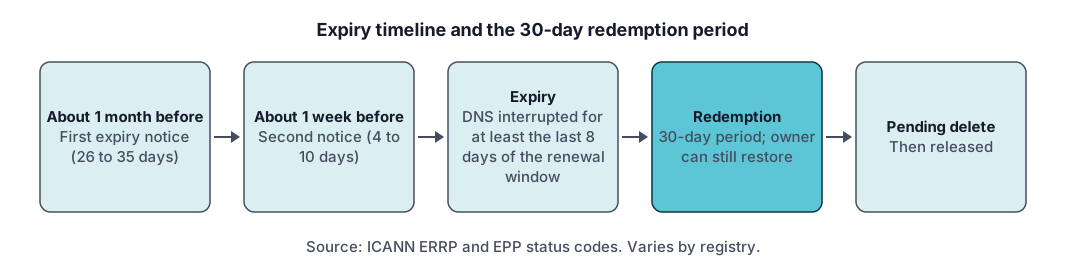
Your site and email can stop working as soon as the registration lapses. Under the Expired Registration Recovery Policy, if the registrar deletes the domain within eight days of expiry, DNS resolution must be interrupted from expiry until deletion. If deletion comes later, resolution must be interrupted for at least the last eight consecutive days the name is renewable. Any page shown during the renewable period must say the registration has expired and explain how to renew.
What is the auto-renew grace period?
The grace period is the time after expiry when your registrar still lets you renew. ICANN’s policy does not fix its length, but the Expired Domain Deletion Policy requires registrars to describe to each new registrant when a non-renewed name would be deleted relative to its expiration date, or a date range of no more than ten days. The policy sets the notices: two before expiry (about a month and a week) and at least one more within five days after. Registrars must describe on their websites how they deliver those notices, and some registries add an autoRenewPeriod, which ICANN describes as a grace period after an automatic renewal with no stated number of days.
What are the redemption period and the redemption fee?
The redemption period is a 30-day recovery window after deletion. gTLD registries must offer it (section 3.1), and registrars must let the registrant redeem during it (section 3.3). In the public record the domain shows redemptionPeriod, and ICANN’s advice is to contact your registrar immediately. A registrar may charge a recovery fee. The recovery policy requires registrars to clearly display these fees and ICANN’s deletion policy says they should disclose the recovery fee. We do not quote amounts, because they are set by registrars and change.
Redemption rules are for gTLD registries. Country-code extensions run their own policies.
What happens in pending delete, and when is the domain released?
Pending delete is the last stage before release. After 30 days in redemption without restoration, ICANN says the domain stays in pendingDelete for “several days” before it is purged, and its redemptionPeriod entry says the purge comes five calendar days after the 30 days end. It can then be re-registered under registry policy. ICANN still advises contacting your registrar immediately if you want to keep a domain in this stage, but do not count on recovery: act before it gets here.
How do you recover your domain, by stage?
Act with your registrar, because only it can renew or restore.
- After expiry, before deletion: renew through your registrar account. DNS is restored once renewal is done.
- In redemptionPeriod: ask the registrar to redeem the domain, and expect a recovery fee.
- In pendingDelete or after purge: contact the registrar at once; if the name is purged it goes to whoever registers it under registry policy. See buying an expired domain.
Use the WHOIS and RDAP lookup tool to read the statuses on a record.
Why do registries and registrars differ?
Policy sets minimums and registrars set their own schedules and fees. The policy covers notices, DNS interruption and the 30-day redemption for gTLD registries. Anything before deletion, including how long you can renew and what it costs, is set by your registrar’s terms, and country-code registries have their own rules. Confirm with your registrar. For the cost of owning a name, see how much a domain name costs.
How do you prevent expiry?
Turn on auto-renew, keep a valid payment method and contact email, and put the date in a calendar. Registrars send the required notices to the contact details on file, so keep them current. See how to check when a domain expires.
Frequently asked questions
Can I renew a domain after it expires?
Usually yes, for a limited time. The Expired Registration Recovery Policy requires registrars to let the registrant renew from expiration through the period when DNS is interrupted, and to restore your DNS settings once you renew. How long that window lasts depends on your registrar's policy, so renew as soon as you notice the expiry.
What is the redemption period?
The redemption period is a recovery window after a domain has been deleted. The policy requires gTLD registries to offer a 30-day Redemption Grace Period, and ICANN's status codes describe redemptionPeriod as the state where the domain is held for 30 days. Recovery in this stage is handled by your registrar and may carry a fee that the registrar must disclose.
Will my site go down when the domain expires?
It may. The policy requires registrars to interrupt DNS resolution for at least the last eight consecutive days a name can still be renewed, when the name is deleted eight or more days after expiry. A registrar may also show a notice page instead. Websites and email that depend on the domain can fail until you renew.
How long is the grace period?
ICANN's policies fix no single number for it. Its status-code page describes autoRenewPeriod as a grace period after an automatic renewal and gives no day count, and the recovery policy leaves the pre-deletion renewal window to registrars. The Expired Domain Deletion Policy does require each registrar to tell new registrants when a non-renewed name would be deleted relative to its expiration date, or a date range of no more than ten days, so your registrar should state it. The only fixed figure is the 30-day redemption period after deletion. Check your registrar's stated deletion and auto-renewal policy.
Who can buy my domain after it expires?
Nobody can register it until it is deleted and purged. ICANN says a domain that has been through redemptionPeriod and pendingDelete without restoration is purged and can then be re-registered under registry policy. Before that the owner can still recover it, so the safest course is to renew before expiry and keep auto-renew on.
Sources and further reading
- ICANN Expired Registration Recovery Policy (icann.org)
- ICANN EPP status codes: what they mean (icann.org)
- ICANN Expired Domain Deletion Policy (icann.org)
You might also like
- Expired Domains: How They Work
What happens when a domain name expires: renewal notices, the grace and 30-day redemption periods, release, and the risks of buying one.
- Check Domain Name Availability
How to check if a domain name is available: use a registrar search for the final answer, a lookup as a hint, and check variations and trademarks.
- How to Check When a Domain Expires
Find a domain's expiration date in a public RDAP or WHOIS record or your registrar account, and why the date can be missing or differ.
- How to Buy an Expired Domain
How to buy an expired domain: why expired does not mean available, the routes to a name, checks before you pay, risks and Google's spam policy.