IP Address WHOIS: ARIN, RIPE and RDAP
- Written by ZonWhois Editorial Team
- Reviewed by ZonWhois Editorial Team
- Last checked
- Published on
- In Whois And Rdap Lookup
An IP address WHOIS or RDAP lookup shows which organization holds the network block an address belongs to, not who is using it or where they live. Five regional internet registries, including ARIN and RIPE NCC, manage these records for their regions. RDAP queries use paths such as /ip/ and return JSON with the network, handle and contacts.
Section of: WHOIS Domain Lookup Explained
An IP address lookup works much like a domain lookup, except the record describes a block of numbers rather than a name. This page covers the registry side: who manages the data, how to query it and how to read it. The domain version is in the WHOIS guide, and you can run a query in the lookup tool.
What IP WHOIS shows
An IP WHOIS record names the holder of a network block, not a person or a street address. For example, ARIN’s Whois returns fields such as Net Range, CIDR, Name, Handle, Net Type, Registration and Last Changed, plus related entities such as organizations and points of contact. Contacts have roles, including Abuse. The holder is often an internet provider or a company, and it may assign addresses on to customers.
The five regional internet registries
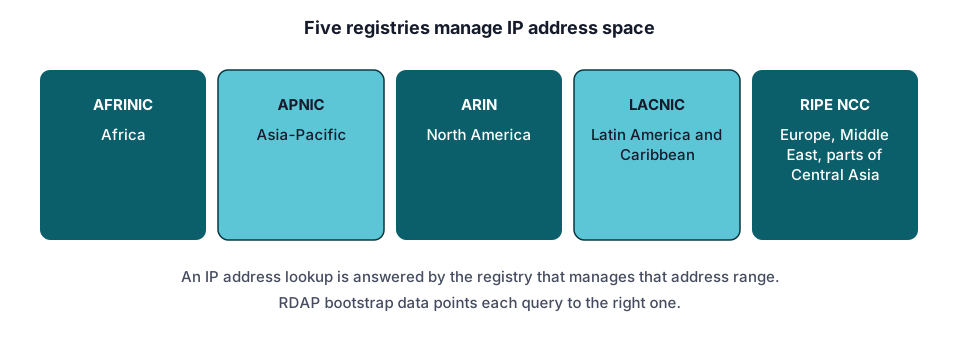
The Number Resource Organization lists five registries that manage, distribute and register IP address space and Autonomous System Numbers in their regions: AFRINIC (Africa), APNIC (Asia Pacific), ARIN (the United States, Canada and many Caribbean and North Atlantic islands), LACNIC (Latin America and the Caribbean) and RIPE NCC (Europe, the Middle East and parts of Central Asia).
Look up an IP through RDAP
RDAP is an HTTP-based protocol, so an IP lookup is a URL. RFC 9082 defines lookup path segments including ip and autnum. ARIN’s RDAP service lives at https://rdap.arin.net/registry/, and ARIN’s own example is https://rdap.arin.net/registry/ip/149.112.152.0/22.
You do not have to know which registry to ask. The bootstrap service rdap.org redirects a request such as https://rdap.org/ip/ followed by an address to the authoritative server, and it only knows about servers registered with IANA. The ZonWhois tool uses that route from your browser. From a terminal, the whois command can query the registries directly.
Reading the result: network, handle, country, abuse contact
- Network or range and CIDR: the block the address belongs to.
- Name and handle: the registry’s identifiers for the holder and the block.
- Country: where the record includes one, it is a registration detail, not a position.
- Registration and last changed: event dates, as RDAP defines them in RFC 9083.
- Abuse contact: the entity with the Abuse role, where reports about misuse should go.
What IP lookup cannot tell you
It cannot give an exact location, a person’s name or a street address, and it cannot tell you who was using an address at a given time. An address can be shared, reassigned or routed through a provider.
IP geolocation is a different dataset
Maps and city names shown by “IP location” websites come from separate estimated datasets, not from the registries. This site does not publish geolocation. Treat any such figure as an approximation.
Reporting abuse
Use the abuse contact in the record, and include the address, timestamps with a time zone and the evidence. For DNS-side checks on a name that points at an address, see reverse DNS lookup, the A record guide and the ICANN lookup comparison.
Record check: claims compared with the cited ICANN, IANA and IETF documents on 2026-11-17.
| Registry | Region served |
|---|---|
| AFRINIC | Africa |
| APNIC | Asia Pacific |
| ARIN | United States, Canada and many Caribbean and North Atlantic islands |
| LACNIC | Latin America and the Caribbean |
| RIPE NCC | Europe, the Middle East and parts of Central Asia |
You do not need to pick a registry yourself: a bootstrap service such as rdap.org routes the query to the registry that manages the address.
Frequently asked questions
Can an IP lookup find someone's address?
No. A WHOIS or RDAP lookup on an IP address returns the organization that holds the network block, such as an internet provider or company, plus technical and abuse contacts. It does not return a home address for the person using the connection. Location guesses you see elsewhere come from separate estimated datasets, not from the registry record.
What is ARIN?
ARIN, the American Registry for Internet Numbers, is the Regional Internet Registry for the United States, Canada and many Caribbean and North Atlantic islands. Like the other four registries, it manages, distributes and registers IP address space and Autonomous System Numbers for its region, and it publishes that data through ARIN Whois and its RDAP service.
Who owns an IP address?
Strictly, a registry record shows who holds the block containing the address, often a provider that assigns addresses to its customers. One address can be shared or reassigned, so the holder is not necessarily the user. Look at the network name, handle and country in the result, and use the abuse contact if you need to report activity.
Is IP WHOIS the same as domain WHOIS?
They use the same ideas but different records. Domain WHOIS describes a registered name through a registrar and registry, while IP WHOIS describes allocations of address space made by a regional internet registry. RDAP covers both with different path types, /domain/ for names and /ip/ or /autnum/ for numbers, so one tool can serve both.
How do I look up an IPv6 address?
Use the same method as IPv4: enter the address or prefix in an RDAP or WHOIS lookup. In an RDAP URL, the /ip/ path takes either form, for example /ip/ followed by the IPv6 address. The registries manage both IPv4 and IPv6 address space, and a bootstrap redirector such as rdap.org sends the query to the right registry.
Sources and further reading
- ARIN: RDAP (arin.net)
- ARIN: Whois (arin.net)
- NRO: The five Regional Internet Registries (nro.net)
- RFC 9082: RDAP Query Format (rfc-editor.org)
- RFC 9083: JSON Responses for RDAP (rfc-editor.org)
- RDAP.org: about the bootstrap service (about.rdap.org)
You might also like
- WHOIS Domain Lookup Explained
What WHOIS and RDAP are, what a domain record shows, why owner details are often redacted, and how to read registrar, dates and status codes.
- Domain Owner Lookup: Who Owns a Domain
How to find who owns a domain name with an RDAP or WHOIS lookup, what to do when the owner is hidden, and how to reach them or report abuse.
- ICANN WHOIS Lookup: WHOIS vs RDAP
How the ICANN lookup relates to WHOIS and RDAP, why RDAP replaced port-43 WHOIS for gTLDs, and how lookup tools differ in what they show.
- The whois Command: Linux, macOS, Windows
How to run the whois command on Linux, macOS and Windows, read its output, and use RDAP from the command line when WHOIS shows too little.
- WHOIS Privacy: What It Is and Whether You Need It
What WHOIS privacy hides, how redaction after GDPR differs from a paid privacy service, what stays public, and what to check at your registrar.