Check Domain Name Availability
- Written by ZonWhois Editorial Team
- Reviewed by ZonWhois Editorial Team
- Last checked
- Published on
- In Expired domains
To check whether a domain name is available, search for it at a registrar, because only a registrar search shows whether you can register it right now. A WHOIS or RDAP lookup that finds no record is a useful hint, not a guarantee. Also check other extensions, spelling variations and trademarks before you buy.
Section of: Expired Domains: How They Work
A registrar’s search is the only reliable way to check whether you can register a domain name today. A lookup that finds no record is a hint. This page sits in the expired domains guide because a name that looks taken may be on its way back to the market.
What is the short answer?
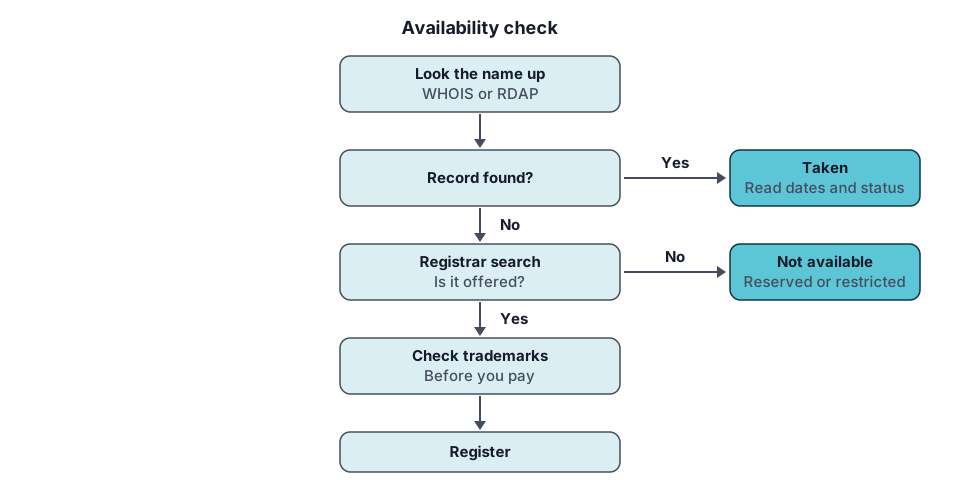
Search at a registrar and look at the result at checkout. A registrar search is the step that decides whether you can register the name and at what price. Use the other methods below to check history and risk first.
How do you do a quick check with a lookup?
Look the name up in our WHOIS and RDAP lookup tool. If a record appears, the name is registered and you can read its dates and statuses. If it finds nothing, treat that as a hint only. Our tools give no availability verdict. RDAP.org, the bootstrap service behind many lookups, returns 404 when it knows of no authoritative RDAP service, which is not the same as the name being free. A name can also be in a deletion stage, such as redemptionPeriod (held 30 days) or pendingDelete (several days before it is purged), per ICANN. See what happens when a domain expires.
What are reserved, premium and unreleased names?
Some names appear unavailable or cost more even though no one holds them. Registries and registrars may reserve names or price some above the standard fee, and a registrar’s search is where you see this. We do not publish prices. If a name is still in its deletion process, it is not yet released. For routes to such names see how to buy an expired domain.
Should you check variations and other extensions?
Yes, before you commit. Check singular and plural forms, hyphens, common misspellings and other extensions, and decide whether a near-match could confuse visitors. The name idea generator can suggest alternatives, and the naming checklist covers the decision.
What about social handles and trademarks?
Check trademarks before you buy a name. The USPTO’s Trademark Search system is the official place to search US trademarks. WIPO explains that under the UDRP a complainant must show trademark rights, that the registrant has no rights in the name, and that it was registered and used in bad faith, so a name built on someone else’s brand can be taken from you. This is general information, not legal advice. Also check that matching social handles are free.
What if the name is registered but unused?
Registered does not mean for sale. You can wait to see whether it expires, contact the owner through the contact route in the record or your registrar, or choose another name. Public records often hide personal contact details, which our WHOIS guide explains.
What should you do when the name is taken?
Pick a variation or another extension, and move on rather than chasing it. Return to the buying guide once you have a name that checks out.
Frequently asked questions
Is a domain that returns "not found" available?
Not necessarily. A lookup that finds no record is a good hint, but it does not tell you whether you can register the name today. The name may be reserved, held in a deletion stage, priced as a premium name, or the lookup service may simply not know the registry. Confirm in a registrar's search before you rely on it.
Why does a checker say taken but the site is empty?
A domain can be registered without hosting anything. People hold names for future projects, resale or defense, and a registered name needs no website. If a lookup shows it as registered, it is not available to register, whatever the page shows. You can contact the owner through the registrar's contact route or wait to see whether it expires.
What is a premium domain?
A premium domain is a name that a registry or registrar prices above the standard registration fee. Whether a name is premium, and its price, are set by the registry or registrar, and the registrar's search result will show it. We do not quote prices because they vary and change. Compare the price shown at checkout with the standard fee.
Can I reserve a name without buying?
Generally not with a normal registration. A name is either registered to someone or it is not, and a registrar search showing it available can change before you check out. Some registrars offer backorders or holds on names that are expiring, with their own terms. Read the terms and fees on your registrar's site before relying on one.
How do I check availability for .org?
Use the same method as for .com: search the name with the .org extension at a registrar, then confirm with a lookup. Each extension has its own registry, and the registry's records are the source of truth. The RDAP bootstrap service routes a query to the right registry, so a lookup tool works for .org as for other extensions.
Sources and further reading
- RDAP.org: bootstrap service (about.rdap.org)
- IETF RFC 9083: JSON Responses for the Registration Data Access Protocol (RDAP) (rfc-editor.org)
- ICANN EPP status codes: what they mean (icann.org)
- WIPO Arbitration and Mediation Center: domain name dispute resolution (wipo.int)
- USPTO: Search our trademark database (uspto.gov)
You might also like
- Expired Domains: How They Work
What happens when a domain name expires: renewal notices, the grace and 30-day redemption periods, release, and the risks of buying one.
- How to Check When a Domain Expires
Find a domain's expiration date in a public RDAP or WHOIS record or your registrar account, and why the date can be missing or differ.
- Domain Expired: Grace and Redemption Periods
What happens after a domain expires: renewal notices, DNS interruption, the 30-day redemption period and pending delete, and how to recover it.
- How to Buy an Expired Domain
How to buy an expired domain: why expired does not mean available, the routes to a name, checks before you pay, risks and Google's spam policy.