How to Choose a Domain Name
- Written by ZonWhois Editorial Team
- Published on
- In Choosing A Domain Name
To choose a domain name, pick something short, easy to say and spell, on an extension your audience will trust, and check availability and trademarks before you buy. Avoid hyphens, numbers and look-alike spellings that people mistype. Keywords in the name are optional, and the technical limits on length and characters are generous.

The best domain names are short, clear and available. Work through the checklist below before you pay anything; the purchase itself is covered in the buying guide, and the name idea generator can give you candidates to test.
The short checklist
- No more than about two words, easy to say aloud.
- Spelled the way it sounds.
- No hyphens or numbers unless they are part of the brand.
- Not a copy or near-copy of an existing brand.
- Available on the extension you want (check availability).
- Passes a test with real people.
Short, clear and easy to say aloud
Say the name to someone and ask them to type it. If they get it wrong, the name has a cost. ICANN describes domain names as built from letters, numbers and hyphens that are easier to remember than IP addresses, so lean on that advantage.
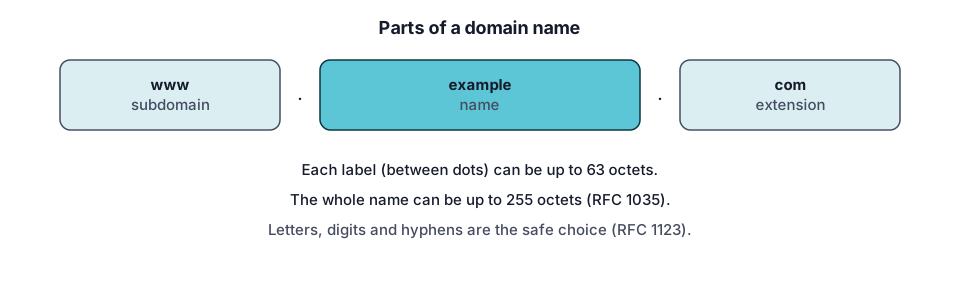
Technical limits are not your constraint. Under RFC 1035, each label (the part between dots) can be 63 octets and the whole name 255 octets, and RFC 1123 requires host software to handle names of up to 63 characters and allows a label to start with a digit as well as a letter. Your practical limit is memory and typing.
Choosing the TLD (.com vs others)
The extension is the part after the last dot. .com is the most familiar and is covered in registering a .com. Other extensions can suit a specific audience, but each is run by its own manager, listed in IANA’s root zone database, and some have eligibility rules. Read the registry’s own page before you register under an unfamiliar extension.
Keywords, brand names and what to avoid
A brand-like name is easier to remember than a string of search terms. Google’s spam policies page does not list keywords in domain names or extensions as a ranking factor, so there is no reason on that page to trade memorability for keywords. The same page defines expired domain abuse as buying an expired domain primarily to manipulate search rankings; do not buy a lapsed name just to borrow its past. See expired domains.
Hyphens, numbers and look-alike spellings
Hyphens and numbers are allowed but make a name harder to say. Look-alike spellings (swapping letters, dropping vowels) invite typing errors and can look like imitation. Names with non-Latin characters are stored in a different form: RFC 5890 says an internationalised label is converted to an A-label with the prefix xn—, and the part after the prefix is limited to 59 ASCII characters. Check how your name displays in the places people will see it.
Trademark and look-alike checks
Search the name in the trademark records before you register it. The USPTO provides a Trademark Search system for this. If someone holds a conflicting mark, a UDRP complaint can force a transfer: WIPO says the complainant must prove all three elements of the policy and that the burden of proof stays on the complainant, and the respondent can defend with, for example, legitimate noncommercial use or being commonly known by the name. This is general information, not legal advice; ask a qualified lawyer about specific disputes.
Check availability and social handles
Check the domain first, then the handles you want on other services. If the .com is taken, look up the holder with the WHOIS guide to see the registrar and dates, then decide whether to change the name or approach the holder.
Test the name on real people
Ask five people to type it after hearing it once, and to say what they expect the site to be about. Fix any common error before you buy.
Common mistakes
- Choosing a name that is a trademark of someone else.
- Choosing a name you cannot say without spelling it.
- Registering several near-identical names and forgetting to renew them.
- Letting the contact email point to a mailbox you do not control.
Next steps: buy and register
When you have a name, follow buying a domain or go straight to how to register a domain name. Our approach to sourcing is described in the editorial policy.
Frequently asked questions
What makes a good domain name?
A good domain name is short, easy to say aloud, easy to spell after hearing it once, and different enough from existing brands to avoid confusion. It should also be available on an extension your audience recognises. If you have to spell it out in a sentence, or explain which hyphen goes where, it will lose visitors to typos.
Should I use my business name?
Usually yes, if it is available and not too long, because people search for and type the name they already know. Check the trademark records first, since someone else may already use the same name in your field. If the exact name is taken, add a short, clear word rather than altering the spelling.
How long should a domain name be?
As short as still clear. The technical limit is generous: a label can be 63 octets and a whole name 255 octets under the DNS specifications. Very long names are hard to type, share and remember, and they get cut off in print. Aim for a name you could say in one breath.
Do keywords in the domain help SEO?
Google's spam policies page, the document that defines what Google treats as spam, does not describe keywords in domain names or extensions as a ranking factor. Pick a name for people first. A keyword can describe what you do, but a name that is brandable and memorable serves visitors better than a string of search terms.
Is .com still the best choice?
It is the most familiar extension, so it is easiest to say by voice and least likely to be mistyped. It is not required. IANA lists many other extensions, each with its own manager and sometimes its own rules. If a different extension fits your name and audience, use it, and consider registering the matching .com if it is free.
Can I change my domain name later?
You can register a new name at any time, but moving a live site or mailbox means redirects, updated records and telling every contact. Search engines and visitors take time to adjust. Choose carefully now. If you do change, keep the old name registered and redirecting for as long as people may still use it.
Sources and further reading
- RFC 1035: Domain names, implementation and specification (rfc-editor.org)
- RFC 1123: Requirements for Internet Hosts, Application and Support (rfc-editor.org)
- RFC 5890: Internationalized Domain Names for Applications, definitions (rfc-editor.org)
- WIPO: domain name dispute resolution (UDRP) (wipo.int)
- USPTO: trademark search (uspto.gov)
- Google Search Central: spam policies (developers.google.com)
- ICANN: Beginner's guide (icann.org)