Register a .com Domain Name
- Written by ZonWhois Editorial Team
- Reviewed by ZonWhois Editorial Team
- Last checked
- Published on
- In Buying Registering Domains
To register a .com domain name, search the name at an ICANN-accredited registrar, pay for a term of one year or more, enter accurate contact details and verify your email. The .com registry is operated by VeriSign under an ICANN agreement that caps the registry's own fee, but each registrar sets its own retail price.

Section of: How to Buy a Domain Name
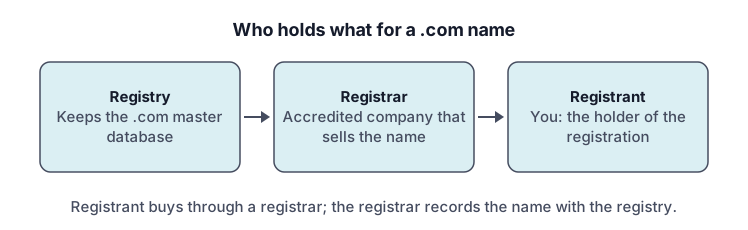
A .com domain name is registered through an ICANN-accredited registrar, which submits it to the .com registry. The general buying process is in the domain buying guide; this page adds what is specific to .com.
What .com is and who runs it (registry vs registrar)
IANA classifies .com as a generic top-level domain, managed by VeriSign Global Registry Services. The registry keeps the master database and publishes a WHOIS server (whois.verisign-grs.com) and an RDAP service (https://rdap.verisign.com/com/v1/). The registrar is the company you pay.
Why .com is common (and why that is not a ranking factor)
.com is familiar and easy to say. That is the whole advantage. Google’s spam policies page, which describes what Google treats as spam, does not mention domain extensions at all, so there is no basis on that page for paying extra for .com to rank better.
Wholesale vs retail: why prices differ
The registry charges registrars a wholesale fee; the registrar adds its own margin and decides the retail price. The agreement between ICANN and VeriSign, effective 1 December 2024, sets the starting Maximum Price for registry services at US $10.26 (section 7.3(d)(i)), and that figure excludes the ICANN variable registry-level fee. Section 7.3(d)(ii) allows increases of up to 7% in each of the final four Pricing Years of every six-year period; the first six-year period began 26 October 2018, and a Pricing Year runs from 26 October to 25 October. The registry must give at least six months’ notice before a price increase. Because the cap may have moved since that agreement, treat $10.26 as a dated starting point (as of 1 December 2024), not today’s price, and check the registry’s current notices. See how much a domain name costs for the retail side.
Register a .com in five steps
- Search the exact name and confirm it is free.
- Choose a registrar and read its renewal price.
- Pick a term; one to ten years may be offered.
- Enter accurate details and pay.
- Verify your email and set DNS records. The steps are laid out in how to register a domain name.
Alternatives when the .com is taken
Try another extension, a different word order, or a modifier that fits your business. Do not register a close misspelling of an existing brand. WIPO describes the UDRP as an online enforcement tool for reclaiming domain names that misuse a brand (cybersquatting), and a complainant must prove three elements. the naming checklist covers trademark and look-alike checks.
Renewal and transfer rules for .com
A registration lasts for its term, and you keep it by renewing before it expires. The registry agreement requires terms of up to ten years to be offered at the price in effect. Moving the name to another registrar is covered in how to transfer a domain.
Record check: claims compared with the cited ICANN, IANA and IETF documents on 2026-11-17; see the editorial policy.
Frequently asked questions
Is .com better than other extensions?
It is the most familiar extension, which helps when you tell someone your address by voice. That is a human reason, not a ranking one: Google's spam policies page does not mention extensions at all. Choose by audience and availability. If a name fits your brand better on another extension, the technical behaviour of the domain is the same.
Who owns .com?
No one owns .com as a name you can buy. IANA records VeriSign Global Registry Services as the manager that runs the .com registry under an agreement with ICANN. Individual .com names are registered by registrants through accredited registrars for a set term. Your registrar is your point of contact; the registry holds the master record.
Can I register a .com for 10 years?
The registry agreement requires VeriSign to keep offering new and renewal .com registrations for periods of up to ten years. Whether you can pick ten years depends on your registrar, which may offer shorter maximums. Check the term options at checkout, and the renewal price for each term.
What if the .com is taken?
Look up the registration to see whether it is active and when it expires, try a variation or another extension, or contact the holder through the registrar if you want to make an offer. Avoid names that imitate a trademark, since a UDRP complaint can force a transfer. The expired domains guide explains what happens when a name lapses.
Can I change the registrar for a .com later?
Yes. Registrations can be moved between accredited registrars under ICANN's transfer policies, and the registry agreement treats a transfer as a separate fee item from new and renewal registrations. Rules about locks and waiting periods vary, so read your registrar's terms and the transfer guide before you start a move, and keep your contact email current.
Sources and further reading
- IANA: .com delegation record (iana.org)
- ICANN and VeriSign: .com Registry Agreement (effective 1 December 2024) (itp.cdn.icann.org)
- Google Search Central: spam policies (developers.google.com)
- WIPO: domain name dispute resolution (wipo.int)
You might also like
- How to Buy a Domain Name
How to buy a domain name in five steps: pick the name, choose an accredited registrar, compare renewal and transfer terms, check out and verify.
- How Much Does a Domain Name Cost?
What a domain name costs depends on the registry fee, the registrar's margin and renewal terms. See what makes up the price and how to compare fairly.
- How to Register a Domain Name Step by Step
Register a domain name in six steps: check the name, open a registrar account, enter accurate details, pick a term, verify your email and set nameservers.