ICANN WHOIS Lookup: WHOIS vs RDAP
- Written by ZonWhois Editorial Team
- Reviewed by ZonWhois Editorial Team
- Last checked
- Published on
- In Whois And Rdap Lookup
ICANN's lookup is a web tool for registration data, and it sits on top of RDAP, the protocol ICANN calls the replacement for WHOIS. WHOIS is a plain-text service on TCP port 43, while RDAP returns structured JSON over HTTPS. For gTLDs, registries and registrars have not been required to offer WHOIS since 28 January 2025, except for .com, .name and .post.

Section of: WHOIS Domain Lookup Explained
The ICANN lookup is a web page where you enter a domain and read its registration data. How it relates to the older WHOIS and the newer RDAP is the most common point of confusion, and it is easy to clear up. The WHOIS guide covers the record itself; this page compares the protocols and the tools. To try a lookup yourself, use the ZonWhois lookup tool.
What the ICANN lookup is
ICANN publishes a lookup at lookup.icann.org for registration data. It is a convenience layer: you type a name and it presents the answer. The page relies on scripts, so check the on-page notes when you use it. What you see depends on the registrar and registry behind the name, and on the redaction rules described in the Registration Data Policy.
WHOIS (port 43) vs RDAP (web, JSON)
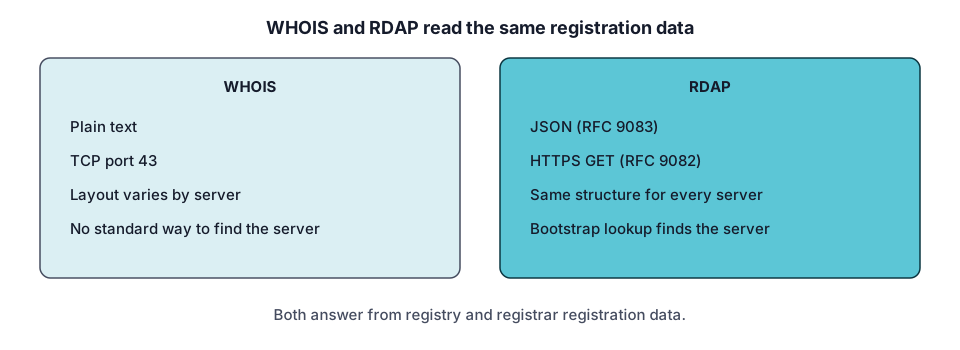
WHOIS sends plain text over TCP port 43, and RDAP sends structured JSON over HTTPS. RFC 3912 describes WHOIS: a client opens a connection, sends a text query ending in a carriage return and line feed, and the server replies and closes the connection. The RFC defines no structured format and no way to declare a character set, and it notes that WHOIS has no access control, integrity or confidentiality features.
RDAP is defined across three documents. RFC 9082 sets URL patterns such as /domain/, /ip/ and /autnum/, used with HTTP GET and HEAD. RFC 9083 sets the JSON response, with object classes for domains, nameservers and entities. RFC 9224 explains how a client finds the authoritative server.
Why RDAP replaced WHOIS for gTLDs
ICANN states RDAP was created as the replacement for the WHOIS protocol and lists three benefits: internationalization support, secure access to data and the ability to find authoritative servers. All gTLD registries and registrars must provide RDAP services under the gTLD RDAP Profile. As of 28 January 2025, registries and registrars are no longer required to provide WHOIS services, except for .com, .name and .post.
How to use lookup.icann.org
- Open the lookup page in a modern browser with scripts enabled.
- Enter the domain, for example example.com.
- Read the registrar, dates, status and any redaction notices in the result.
- For a name that appears to be available, treat the result as a hint and confirm with a registrar.
How to read the result
The fields match the ones in the record anatomy: registrar, creation, update and expiry dates, status codes, nameservers and contacts. Where the registrant is hidden, expect a redaction notice and a relay email or form. If you need to reach someone, see domain owner lookup.
Differences between ICANN’s lookup, registrar lookups and this site’s tool
All three read the same underlying registration data, so the facts should agree, though layout and field names differ. Registrars run their own lookups for the names they manage. This site’s tool runs in your browser, asks the RDAP bootstrap redirector rdap.org, and displays the result. If two tools disagree, compare the updated date and check which server answered.
Limits: ccTLDs and redaction
ICANN’s gTLD policies do not bind country-code registries, so .de, .uk or .ai records can look quite different and may be limited or unavailable. Redaction affects every gTLD lookup. For IP addresses, use IP address WHOIS and RDAP; for the command line, see the whois command.
Record check: claims compared with the cited ICANN, IANA and IETF documents on 2026-11-17.
| Feature | WHOIS (RFC 3912) | RDAP (RFC 9082, 9083, 9224) |
|---|---|---|
| Transport | TCP port 43 | HTTPS |
| Response format | Human-readable text, no defined structure | JSON with defined object classes |
| Finding the right server | Client must know the server | IANA bootstrap registry (RFC 9224) |
| Access control | None built in | Uses HTTP, so standard web security applies |
| gTLD requirement | Not required since 28 January 2025, except .com, .name, .post | Required under the gTLD RDAP Profile |
Use RDAP for anything automated or any tool you build, and treat WHOIS as a legacy interface for quick checks. For people, a web lookup hides the difference.
Frequently asked questions
Is ICANN lookup the same as WHOIS?
No. ICANN's lookup is a web tool for retrieving registration data, while WHOIS is an older protocol defined in RFC 3912 that returns plain text over TCP port 43. ICANN says RDAP was created as the replacement for the WHOIS protocol. The tool and the protocols answer the same kind of question, but they are not the same thing.
Is port-43 WHOIS going away?
For gTLDs it is no longer mandatory. As of 28 January 2025, ICANN says registries and registrars are no longer required to provide WHOIS services, except for .com, .name and .post. Some operators may keep offering it, and country-code registries make their own choices. For new tools and scripts, RDAP is the protocol to build on.
What is RDAP?
RDAP, the Registration Data Access Protocol, is the IETF standard for querying registration data about domains, IP addresses and autonomous system numbers. Queries are HTTPS requests and answers are JSON documents. RFC 9082 defines the query format, RFC 9083 the response format and RFC 9224 how to find the right server. ICANN describes it as the replacement for WHOIS.
Does ICANN own the WHOIS data?
No. The registration data is created and held by the registrars and registry operators that run each domain, and they publish it under ICANN's contracts and policies. ICANN sets the rules for gTLDs, including the Registration Data Policy, but it is not the source of an individual record. Country-code domains follow their own registry's rules.
Why does a lookup show no registrant?
Because policy usually requires it. Under ICANN's Registration Data Policy, effective 21 August 2025, fields such as registrant name, street, postal code and phone must be redacted where required to comply with applicable law, and the output must show that they are redacted. A relay email address or web form is provided so you can still send a message.
Sources and further reading
- ICANN: Registration Data Access Protocol (RDAP) (icann.org)
- ICANN: Registration Data Policy (icann.org)
- RFC 3912: WHOIS Protocol Specification (rfc-editor.org)
- RFC 9082: RDAP Query Format (rfc-editor.org)
- RFC 9083: JSON Responses for RDAP (rfc-editor.org)
- RFC 9224: Finding the Authoritative RDAP Service (rfc-editor.org)
- IANA: Bootstrap Service Registry for Domain Name Space (iana.org)
- ICANN Lookup (lookup.icann.org)
You might also like
- WHOIS Domain Lookup Explained
What WHOIS and RDAP are, what a domain record shows, why owner details are often redacted, and how to read registrar, dates and status codes.
- Domain Owner Lookup: Who Owns a Domain
How to find who owns a domain name with an RDAP or WHOIS lookup, what to do when the owner is hidden, and how to reach them or report abuse.
- IP Address WHOIS: ARIN, RIPE and RDAP
How an IP address WHOIS or RDAP lookup works, what the five regional internet registries publish, and what the result can and cannot tell you.
- The whois Command: Linux, macOS, Windows
How to run the whois command on Linux, macOS and Windows, read its output, and use RDAP from the command line when WHOIS shows too little.
- WHOIS Privacy: What It Is and Whether You Need It
What WHOIS privacy hides, how redaction after GDPR differs from a paid privacy service, what stays public, and what to check at your registrar.