WHOIS Privacy: What It Is and Whether You Need It
- Written by ZonWhois Editorial Team
- Reviewed by ZonWhois Editorial Team
- Last checked
- Published on
- In Whois And Rdap Lookup
WHOIS privacy keeps a domain registrant's personal contact details out of the public record. Since ICANN's Registration Data Policy took effect on 21 August 2025, many of those fields must be redacted by default where required, so a separate privacy service matters less than it once did. Registrar, dates, status and an abuse contact stay public either way.

Section of: WHOIS Domain Lookup Explained
WHOIS privacy keeps the personal details of a domain’s registrant out of public view. This page, part of the WHOIS guide, explains what is hidden, what is not, and what has changed since data-protection law reshaped the record.
What WHOIS privacy hides
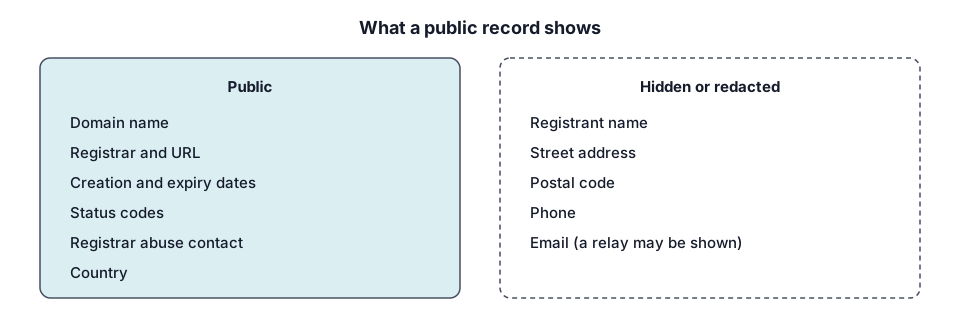
WHOIS privacy hides the registrant’s personal contact details from the public record. These are the name, street address, postal code, phone and email. The registrar and registry still hold the real data; privacy controls what a public lookup shows. Check any domain with the WHOIS lookup tool.
How it changed after GDPR
The GDPR was adopted by the EU on 14 April 2016 and took effect on 25 May 2018. ICANN has described its goal as striking a balance between securing individual privacy rights and maintaining the safety and security of the Internet. A Temporary Specification for gTLD Registration Data followed and expired on 25 May 2019; an Interim Registration Data Policy applied until 20 August 2025. The current Registration Data Policy is effective from 21 August 2025.
Under it, redaction is required where needed to comply with applicable law, and may also be applied for a commercially reasonable purpose or when limiting it is not technically feasible. Redaction means the value is not included in the output, and the output must indicate that it is redacted.
Privacy service vs redaction vs proxy
These are easy to confuse.
- Redaction is the registry or registrar leaving fields out of the output, governed by policy.
- A privacy service is an add-on offered by a registrar that replaces or hides your details in the record.
- A proxy service lists a third party as the registrant and licenses the name to you. Terms vary, so read them: the named registrant may be the service rather than you.
Because contracts differ, check who is listed as the registrant in your registrar’s terms. This site cannot say what a particular registrar does.
What stays public
The policy requires the domain name, registrar details and URL, creation date, domain status, the registrar’s abuse contact email and phone, and the last update of the record to be published. The registrant’s country, and state or province if collected, is also published. Redaction of Registrant Organization and Registrant City is optional.
When privacy is not available
Not every top-level domain follows ICANN’s gTLD policy. Country-code registries set their own rules, and some publish or hide different fields. The policy leaves some fields, such as Registrant Organization and Registrant City, to the registrar’s choice. If privacy matters, look at a live record of the same TLD, and ask your registrar before you register.
Risks: reachability and legal disclosure
Privacy is not a shield from every party. Messages sent to a relay address are forwarded, so a mailbox you never check means missed notices. Registrars and registry operators must publish how to request nonpublic data, and they can disclose it in response to a valid request. ICANN’s Registration Data Request Service is a standard intake for those requests but does not itself guarantee disclosure. Keep your underlying contact details accurate and current with your registrar.
How to check whether a domain has privacy
Run the name through the lookup tool. A redacted record shows a notice in place of the value, or a relay address or form. If you see a real name and street, there is no privacy applied for that field. The whois command guide shows the same check from a terminal.
How to turn it on at your registrar
Registrars differ, but the generic steps are:
- Sign in and open the domain’s settings.
- Look for a section labelled privacy, WHOIS or contact information.
- Read what the service covers and what it costs, if anything.
- Enable it, then run a fresh lookup after a short wait to confirm what the public record shows.
Before registering, see how to register a domain name; if you plan to move a name, see how to transfer a domain. To reach an owner who is hidden, read domain owner lookup. More on how we handle sources is on the editorial policy page.
Record check: claims compared with the cited ICANN, IANA and IETF documents on 2026-11-17.
Frequently asked questions
Is WHOIS privacy worth it?
It depends on the domain and the registrar. For many gTLD registrations, the main personal fields are already redacted by default under ICANN's Registration Data Policy, so a privacy add-on may add little. It can still matter for top-level domains with different rules, or where a registrar redacts fewer fields. Check what your own record shows in a lookup before deciding.
Is WHOIS privacy free?
Registrars set their own terms, and some include privacy with the registration while others sell it separately. This site does not quote prices, because they change and vary by registrar and TLD. Look at the checkout page or account settings of your registrar. Redaction required by ICANN policy applies whether or not you buy any add-on.
Does privacy protect against spam?
Hiding your email and phone from the public record removes one common source of unsolicited messages, but it does not stop spam from other sources, and it does not remove the abuse contact or relay form that must remain. Registrars that redact emails must offer a relay address or web form, so some messages can still reach you through it.
Can anyone still find the owner?
Not from the public record, but yes through formal routes. Registrars and registry operators must publish how to submit requests for nonpublic data, acknowledge them within two business days and respond within 30 calendar days of acknowledgement, absent exceptional circumstances. They may deny a request with reasons.
Does privacy affect transfers?
Redaction does not itself block a transfer, which is controlled by the transfer lock status and your authorization code. Your registrar may switch privacy off or on during the move, and contact details can matter for confirmation emails. Read the steps in the transfer guide and confirm with both registrars before you start.
Sources and further reading
- ICANN: Data protection and privacy (icann.org)
- ICANN: Registration Data Policy (icann.org)
- ICANN: Consensus policies (icann.org)
- RFC 9083: JSON Responses for RDAP (rfc-editor.org)
You might also like
- WHOIS Domain Lookup Explained
What WHOIS and RDAP are, what a domain record shows, why owner details are often redacted, and how to read registrar, dates and status codes.
- Domain Owner Lookup: Who Owns a Domain
How to find who owns a domain name with an RDAP or WHOIS lookup, what to do when the owner is hidden, and how to reach them or report abuse.
- ICANN WHOIS Lookup: WHOIS vs RDAP
How the ICANN lookup relates to WHOIS and RDAP, why RDAP replaced port-43 WHOIS for gTLDs, and how lookup tools differ in what they show.
- IP Address WHOIS: ARIN, RIPE and RDAP
How an IP address WHOIS or RDAP lookup works, what the five regional internet registries publish, and what the result can and cannot tell you.
- The whois Command: Linux, macOS, Windows
How to run the whois command on Linux, macOS and Windows, read its output, and use RDAP from the command line when WHOIS shows too little.