How to Buy a Domain Name
- Written by ZonWhois Editorial Team
- Reviewed by ZonWhois Editorial Team
- Last checked
- Published on
- In Buying Registering Domains
To buy a domain name, pick a name and extension, check that it is free, choose an ICANN-accredited registrar, compare renewal and transfer terms, then pay and verify your contact email. You are registering the name for a fixed term, not buying it outright, so the renewal date matters as much as the first-year price.

Buying a domain name means registering it through a registrar for a set term, and the process takes about fifteen minutes once you know what to compare. Think of five steps: choose the name, check it is free, pick a registrar, pay and fill in your details, then verify and set DNS. The details of the checkout form are in how to register a domain name step by step.
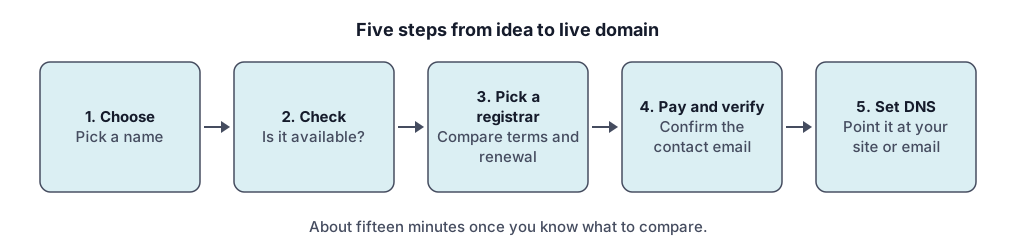
The short answer: five steps
- Choose the name and extension. Short, easy to say aloud, and not a copy of a brand someone else owns. The naming checklist guide has a checklist, and the domain name generator can suggest options.
- Check availability. Search the exact name at a registrar or use the steps in domain name availability checker.
- Pick an accredited registrar. See the comparison list below.
- Pay and enter your details. Use accurate contact details and a mailbox you control.
- Verify your email and set DNS. Until the records exist, the name does not point anywhere.
Before you buy: pick the name and TLD
The extension (TLD, the part after the last dot) is a separate choice from the name. IANA lists every TLD with its manager; for example .com is a generic top-level domain managed by VeriSign Global Registry Services. Some extensions have their own eligibility rules, so read the registry’s page for any extension other than .com. For .com specifics, see registering a .com.
ICANN describes the domain name system as using letters, numbers and hyphens to form names that are easier to remember than IP addresses. A name that is easy to type and say will serve you better than a clever one.
Registrar or reseller: what you are actually buying
Three parties sit behind every registration:
- Registry: runs the master database for an extension. VeriSign does this for .com.
- Registrar: the company that sells you the registration and submits it to the registry.
- Registrant: you, the holder of the registration for its term.
A reseller sells registrations on behalf of a registrar. The registrar’s contract with ICANN, the Registrar Accreditation Agreement, still sets the baseline rules for names in generic TLDs, so a reseller’s terms sit on top of that.
What to compare (renewal terms, transfer rules, WHOIS privacy, support)
This page does not rank registrars. Compare any registrar on the same short list, using the registrar’s own current terms:
| What to check | Why it matters |
|---|---|
| Renewal price and when it is shown | First-year and renewal prices can differ; the renewal price is what you pay every later year |
| Term lengths offered | .com can be registered for up to ten years at the registry level, but a registrar may offer fewer |
| Transfer rules | You should be able to move the name to another registrar; see how to transfer a domain |
| WHOIS or RDAP privacy | Whether contact details are redacted by default, and whether that costs extra; see WHOIS privacy |
| Account security | Two-factor login for the account that controls the name |
| Auto-renew and expiry notices | What happens, and what you are told, if a payment fails; see expired domains |
Checkout step by step
Search the name, add it to the cart, choose the term (one year is fine to start, longer if you want to avoid a renewal date), decline add-ons you do not need, and enter the registrant details. Those details must be accurate. ICANN’s Registrar Accreditation Agreement requires the registrant to provide accurate contact information and correct it within seven days of any change, and inaccurate details can be grounds for suspension or cancellation.
After you buy: verify email, contacts, DNS
Expect a verification email. Under ICANN’s WHOIS Accuracy Program Specification, the registrar must validate and verify contact data within fifteen days of a new registration, and if you do not respond it must verify manually or suspend the registration. Click the link as soon as it arrives. Then:
- Check the nameservers your registrar assigned.
- Add the DNS records you need. DNS records explained covers the types.
- Look up your name afterwards with the DNS lookup tool to confirm what is published.
Buying a name someone already owns
A taken name is not necessarily unavailable. Look up the registrar and dates in the WHOIS guide; most owner details are redacted, but the registrar can often pass on an offer. Never register a name that mimics a trademark in the hope of selling it: WIPO describes the UDRP as an online enforcement tool for reclaiming domain names that misuse a brand (cybersquatting).
Common traps (renewal pricing, add-ons, look-alike renewal notices)
- Introductory prices. Read the renewal price on the checkout page, not only the first-year price.
- Bundles. Privacy, email and site builders are separate products; you can often buy the name alone.
- Fake renewal notices. Mail or email claiming your domain is about to expire and asking you to pay a different company is a known scam pattern. Renew only inside your registrar account, and compare any notice with the registrar and expiry date shown there.
- Wrong contact email. A notice sent to an address you no longer read is a common cause of lost names.
Costs: what to expect
Prices vary by registrar, extension and year, and this site quotes a figure only when it has a dated primary source. For the factors behind the price, see how much a domain name costs. Record check: claims compared with the cited ICANN, IANA and IETF documents on 2026-11-17; see the editorial policy.
All Buying Registering Domains guides
- How Much Does a Domain Name Cost?
What a domain name costs depends on the registry fee, the registrar's margin and renewal terms. See what makes up the price and how to compare fairly.
- How to Register a Domain Name Step by Step
Register a domain name in six steps: check the name, open a registrar account, enter accurate details, pick a term, verify your email and set nameservers.
- Register a .com Domain Name
Register a .com domain name: who runs .com, how registry and registrar differ, the five steps, renewal rules and what to try if the .com is taken.
Frequently asked questions
How much does it cost to buy a domain name?
There is no single price. A registrar sets its own retail price on top of the registry's wholesale fee, and first-year and renewal prices often differ. For .com, the registry agreement caps the registry's own charge, which is only one part of what you pay. See the cost guide for the factors to compare, and read the renewal price before you check out.
Can I buy a domain name permanently?
No. A domain registration is a term, not a purchase of ownership. For .com the registry must offer terms of up to ten years, and you keep the name by renewing before it expires. Some registrars offer auto-renewal. Keep your contact email current so renewal notices reach you, and note the expiry date in your own calendar.
Do I need hosting to buy a domain?
No. A domain name is a registration entry, separate from any website or mailbox. You can register a name first and add DNS records later, when you know where you want it to point. This site covers the domain and DNS side only, so see the DNS records guide for what those records do.
What is a registrar?
A registrar is a company that sells domain registrations to the public and records them with the registry that runs the extension. For generic names such as .com, registrars are accredited by ICANN and must follow its policies. The registry, such as VeriSign for .com, holds the master database for that extension.
How long does it take for a new domain to work?
The registration itself is recorded when your order completes, but a name only resolves to a site or mailbox once DNS records exist and caches expire. Each record carries a time to live, the maximum time a resolver may cache it. Changes you make later can take up to that long to show everywhere.
What if the name I want is taken?
Look up who holds it and whether it is for sale, try another extension, or change the name. A WHOIS or RDAP lookup shows the registrar and dates, though the owner's contact details are often redacted. Do not register close misspellings of someone else's brand, which can lead to a UDRP complaint.
Sources and further reading
- IANA: .com delegation record (iana.org)
- ICANN and VeriSign: .com Registry Agreement (effective 1 December 2024) (itp.cdn.icann.org)
- ICANN: 2013 Registrar Accreditation Agreement and specifications (icann.org)
- ICANN: Consensus policies for registrars (icann.org)
- ICANN: Beginner's guide (icann.org)
- RFC 8499: DNS Terminology (rfc-editor.org)
You might also like
- How Much Does a Domain Name Cost?
What a domain name costs depends on the registry fee, the registrar's margin and renewal terms. See what makes up the price and how to compare fairly.
- Register a .com Domain Name
Register a .com domain name: who runs .com, how registry and registrar differ, the five steps, renewal rules and what to try if the .com is taken.
- How to Register a Domain Name Step by Step
Register a domain name in six steps: check the name, open a registrar account, enter accurate details, pick a term, verify your email and set nameservers.