How to Buy an Expired Domain
- Written by ZonWhois Editorial Team
- Reviewed by ZonWhois Editorial Team
- Last checked
- Published on
- In Expired domains
To buy an expired domain, first confirm it is actually released: a domain in redemptionPeriod or pendingDelete still belongs to its owner. Once it can be registered, buy it at a registrar like any new name. Check its history and trademark risk first, and avoid buying only for borrowed search rankings, which Google treats as spam.

Section of: Expired Domains: How They Work
Record check: claims compared with the cited ICANN and Google documents on 2026-11-17.
Expired does not mean available. The original owner may still renew or redeem the name, and it only reaches the market after deletion and release. This page covers buying once that happens, within our expired domains guide.
What can you actually buy?
You can buy a name only after it has been released. A domain in redemptionPeriod is held for 30 days and the owner can still restore it. A domain in pendingDelete stays several days before it is purged and can then be registered again under registry policy, according to ICANN. Read the status with the WHOIS and RDAP lookup tool. The stages are explained in domain expiration, grace and redemption periods.
What are the routes?
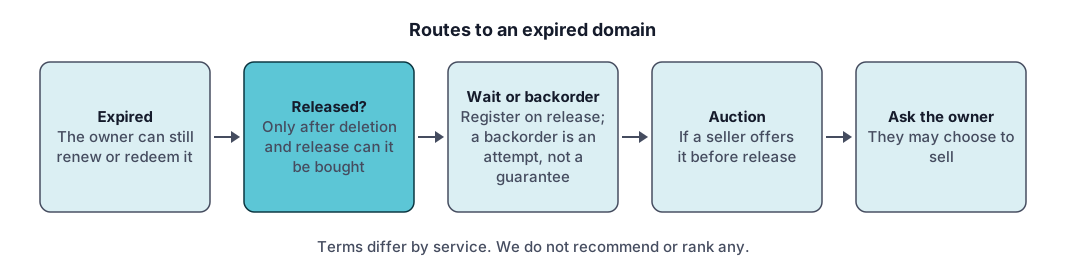
There are four routes, each with its own terms.
- Wait for release, then register it at a registrar the way you would any new name. See how to check domain name availability.
- Place a backorder with a registrar or service that tries to register the name when it is released. It is an attempt, not a guarantee.
- Buy at an auction if a registrar or marketplace sells names before release. Read the terms and what the winning bid includes.
- Ask the owner. A registered name can be bought from its owner if they choose to sell, but nothing obliges them to.
Backorder and auction terms are set by each service, so rely on the terms of whichever one you use. We do not recommend or rank any.
What should you check before you pay?
Check the name’s history, trademark risk and what Google may think of it.
- History. See what the domain was used for before. A site previously used for something unsavory can leave an unwanted reputation.
- Trademarks. Search the USPTO’s Trademark Search system. WIPO explains that under the UDRP a complainant must show trademark rights, that the registrant has no rights in the name, and bad-faith registration and use.
- Spam policy. Google defines expired domain abuse as buying an expired domain and repurposing it primarily to manipulate rankings by hosting content of little to no value. Its examples include affiliate content on a former government agency site and casino content on a former elementary school site.
What are the steps once it is released?
Register it like any other name.
- Confirm in a registrar search that the name is available.
- Pick the registration term and complete the checkout with accurate contact details.
- Turn on auto-renew and the transfer lock. If you later move the name, plan for the waiting time: see how long a transfer takes.
- Look the name up again to confirm the record and the expiry date.
The general buying steps are in the general buying guide.
What are the risks and scams?
Watch for names sold with promises of rankings, “free” offers with high renewal prices, and look-alike renewal notices. Pay only through a registrar or service whose terms you have read. Do not accept promises of guaranteed rankings or traffic. If you are the owner of a name, renew only through your own registrar account.
Is it free?
Usually not. A released domain is registered at the registrar’s normal price, and desirable names may draw several buyers. We do not quote prices, because they change and vary by extension, so read the price shown at checkout.
Frequently asked questions
Can I get an expired domain for free?
Generally no. Once a name is released, it is registered like any other at the registrar's price. Be careful with offers of free expired domains: read the terms and the renewal price. We do not quote prices because they change; check the fee at your registrar.
How do backorders work?
A backorder is a request, usually through a registrar or a broker, to try to register a name when it is released. It is not a guarantee: the name is only released if the owner does not renew or redeem, and several buyers may want the same one. Services set their own terms and fees, so read them before you pay.
Is it safe to buy an expired domain?
It carries risks. The name may have an unwanted history, may infringe a trademark, or may be bought mainly for its rankings, which Google's spam policy calls expired domain abuse when the content has little value. Check what it was used for and search trademarks first. Buy only through a registrar or service whose terms you have read.
Will an expired domain keep its Google ranking?
Do not count on it. Google's spam policy treats buying an expired domain to manipulate rankings with little-value content as abuse. Buy a name because it suits your project, and build useful content on it, rather than for borrowed rankings.
How long until an expired domain drops?
There is no single number. The registrar's own renewal window varies, then gTLD registries must offer a 30-day redemption period, and ICANN says a domain stays in pendingDelete for several days before it is purged. The exact date depends on the registrar and registry, so ask your registrar for its schedule.
Sources and further reading
- ICANN EPP status codes: what they mean (icann.org)
- ICANN Expired Registration Recovery Policy (icann.org)
- ICANN Expired Domain Deletion Policy (icann.org)
- Google Search Central: spam policies (expired domain abuse) (developers.google.com)
- WIPO Arbitration and Mediation Center: domain name dispute resolution (wipo.int)
- USPTO: Search our trademark database (uspto.gov)
You might also like
- Expired Domains: How They Work
What happens when a domain name expires: renewal notices, the grace and 30-day redemption periods, release, and the risks of buying one.
- Check Domain Name Availability
How to check if a domain name is available: use a registrar search for the final answer, a lookup as a hint, and check variations and trademarks.
- How to Check When a Domain Expires
Find a domain's expiration date in a public RDAP or WHOIS record or your registrar account, and why the date can be missing or differ.
- Domain Expired: Grace and Redemption Periods
What happens after a domain expires: renewal notices, DNS interruption, the 30-day redemption period and pending delete, and how to recover it.