What Is a Domain Name?
- Written by ZonWhois Editorial Team
- Published on
- In Buying Registering Domains
A domain name is a readable label, such as example.com, that stands in for the numeric IP address of a computer on the internet. The Domain Name System (DNS) translates the name into that address. A domain name is not a website: it is a name you register, which you then point at web, email or other services.
Section of: How to Buy a Domain Name
A domain name is a readable name, such as example.com, that stands in for the numeric address of a computer on the internet. If you are about to get one, the guide to buying a domain name covers the purchase itself; this page explains what you are actually buying.
What a domain name is
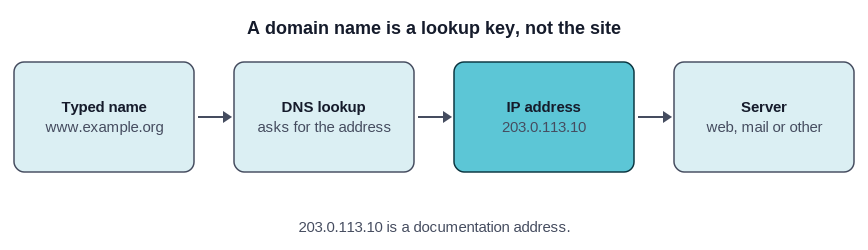
Every computer on the internet is reached by an IP address, a long string of numbers that is hard to remember. ICANN describes a domain name as the easy replacement for that number, and the Domain Name System (DNS) as the service that looks the number up. Type a name, and DNS returns the address behind it.
ICANN’s own comparison is a street address used for postal mail. The address tells the carrier where to go, but it is not the house, and it says nothing about what is inside.
A domain name is not a website
This is the most common confusion. Registering a name creates a new named realm in the DNS, and nothing more. To make it do something you add records that point it at a web server, a mail service or another system. ICANN is explicit that you still need services such as web hosting or email.
That is why one name can have a website, a separate mail setup and a handful of subdomains, each pointed somewhere different. The records that do the pointing are covered in DNS records explained.
The parts of a domain name
Names are read from right to left, with dots between the levels. ICANN uses whois.icann.org as its example:
- org is the top-level domain (TLD), the first level.
- icann is the second level.
- whois is the third level.
ICANN adds that a name can have up to 128 levels, though real names rarely have more than three or four. At each dot, authority can be handed to another party. The community sets the rules for top-level domains, the operator of .org sets the rules for registering names under it, and the holder of icann.org decides what happens below it. This handing-over is called delegation, and RFC 1034 describes the same structure as a tree in which each node has a label.
What you may put in a name
The original host-name rules in RFC 1035 say a label should start with a letter, end with a letter or digit, and contain only letters, digits and hyphens in between. Two size limits apply:
| Item | Limit | Source |
|---|---|---|
| One label (text between dots) | 63 characters or less | RFC 1035 |
| Whole domain name | 255 octets or less | RFC 1035 |
| Letter case | Not significant | RFC 1035 |
Names in other writing systems are handled by internationalized domain names. RFC 5890 defines a U-label (the Unicode form people read) and an A-label (the ASCII form stored in DNS, which always begins with xn—). Registries can add their own rules on top, so a name valid in the DNS may still be refused at registration.
Domain name vs URL vs IP address
- IP address: the numeric address a computer uses.
- Domain name: the readable name that maps to one or more addresses, for example www.example.com.
- URL: the full web address, which contains a domain name plus a protocol and a path, for example https://www.example.com/about/.
Changing the IP address behind a name does not change the name, which is exactly why names exist.
Who owns and runs a name
You do not buy a name forever. A registrant holds a registration for a set term and renews it; the details of terms and what happens at the end are in expired domains. Public registration data about a name is available through the WHOIS lookup tool, although much personal detail is now hidden.
How to choose and register one
Pick a name people can spell and say aloud, check it is free, then register it through an accredited registrar. The step-by-step version is in how to register a domain name, and ideas for finding a name are in domain name ideas.
Common mistakes: assuming that owning a name means you have a website, forgetting that registrations expire, and entering contact details you cannot receive mail at.
Record check: claims compared with the cited ICANN and IETF documents on 2026-11-18; see the editorial policy.
Frequently asked questions
What is a domain name in simple terms?
A domain name is the text people type to reach something on the internet, such as example.com. Behind the scenes computers use numeric IP addresses, and the Domain Name System translates the readable name into the number. ICANN compares a domain name to a street address used for postal mail.
Is a domain name the same as a website?
No. A domain name is only a name that you register. A website is content served from a computer. You connect the two with DNS records, and the same name can also be used for email or other services. ICANN notes you still need services such as web hosting or email.
What is the difference between a domain name and a URL?
A domain name is one part of a URL. In https://www.example.com/about/, the domain name part is www.example.com, the https:// is the protocol, and /about/ is the path to a page. One domain name can serve many URLs, and changing a page path changes the URL without changing the domain name.
What are the parts of a domain name?
Dots separate the levels, read right to left. In whois.icann.org, org is the top-level domain, icann is the second level and whois is the third. Each level can be handed to a different party to manage, which is called delegation.
What characters can a domain name contain?
The classic rule for host names is letters, digits and hyphens, starting with a letter and ending with a letter or digit, from RFC 1035. Each label can be up to 63 characters. Names with other scripts use internationalized encoding, which appears as labels beginning xn-- in the system.
Sources and further reading
- ICANN: About domain names (icann.org)
- RFC 1034: Domain names, concepts and facilities (rfc-editor.org)
- RFC 1035: Domain names, implementation and specification (rfc-editor.org)
- RFC 5890: Internationalized domain names for applications, definitions (rfc-editor.org)
You might also like
- How to Buy a Domain Name
How to buy a domain name in five steps: pick the name, choose an accredited registrar, compare renewal and transfer terms, check out and verify.
- How Much Does a Domain Name Cost?
What a domain name costs depends on the registry fee, the registrar's margin and renewal terms. See what makes up the price and how to compare fairly.
- Register a .com Domain Name
Register a .com domain name: who runs .com, how registry and registrar differ, the five steps, renewal rules and what to try if the .com is taken.
- How to Register a Domain Name Step by Step
Register a domain name in six steps: check the name, open a registrar account, enter accurate details, pick a term, verify your email and set nameservers.